
Why we don't delegate code review to AI
Agents write the code and humans review all of it. Five reasons, mostly psychological, that keep us from starting to delegate review.

Translated from French with AI. Read the original.
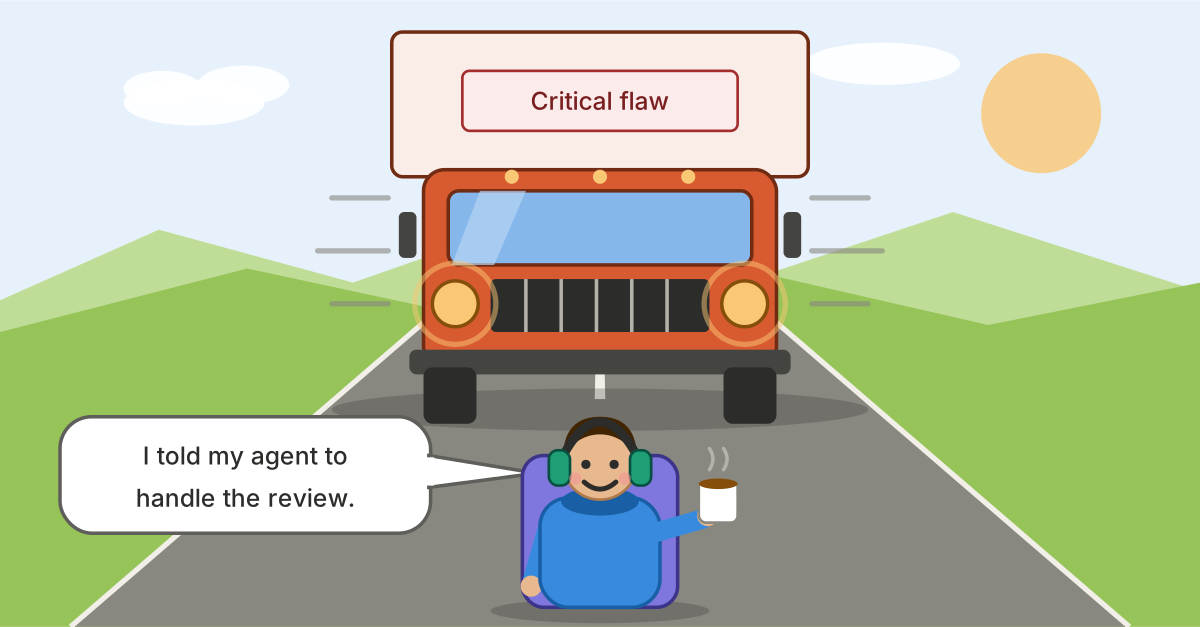
"AI code review isn't reliable. So I do it by hand."
That reasoning fits in two sentences and it sounds solid. In the previous post, I described what it leads to: agents writing a lot of code, humans reviewing all of it, and a lot of people not coping well. This time, I’m looking for what keeps us from delegating even part of it. I see five brakes.
1. Fear of the error we won’t see
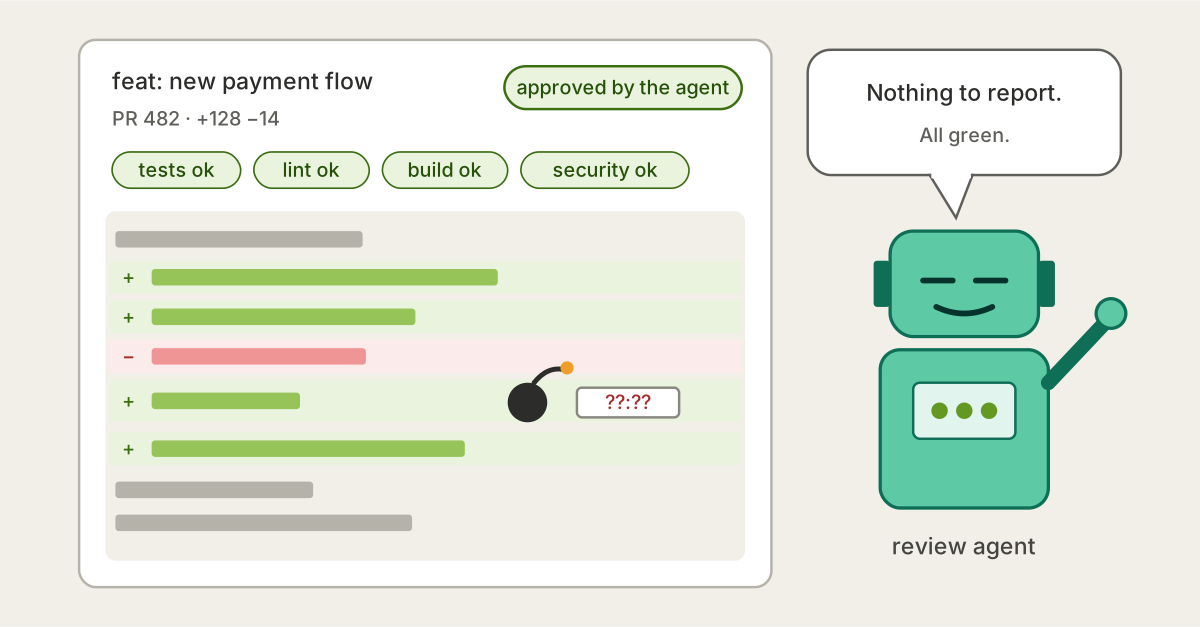
What scares people is the serious errors the agent might let through: a security hole, a nasty bug, that crosses the review silently and turns up in production weeks later. When my colleagues review a PR, I know their strengths and their blind spots. With an agent, I don’t know when I’ll find out, or how much it will cost me by then.
For many people, this fear has a precise origin. They tried once, the agent missed something obvious, and they never tried again. One error was enough. And you tell yourself that the next one, you might not see.
2. We confuse delegating with getting it 100% right
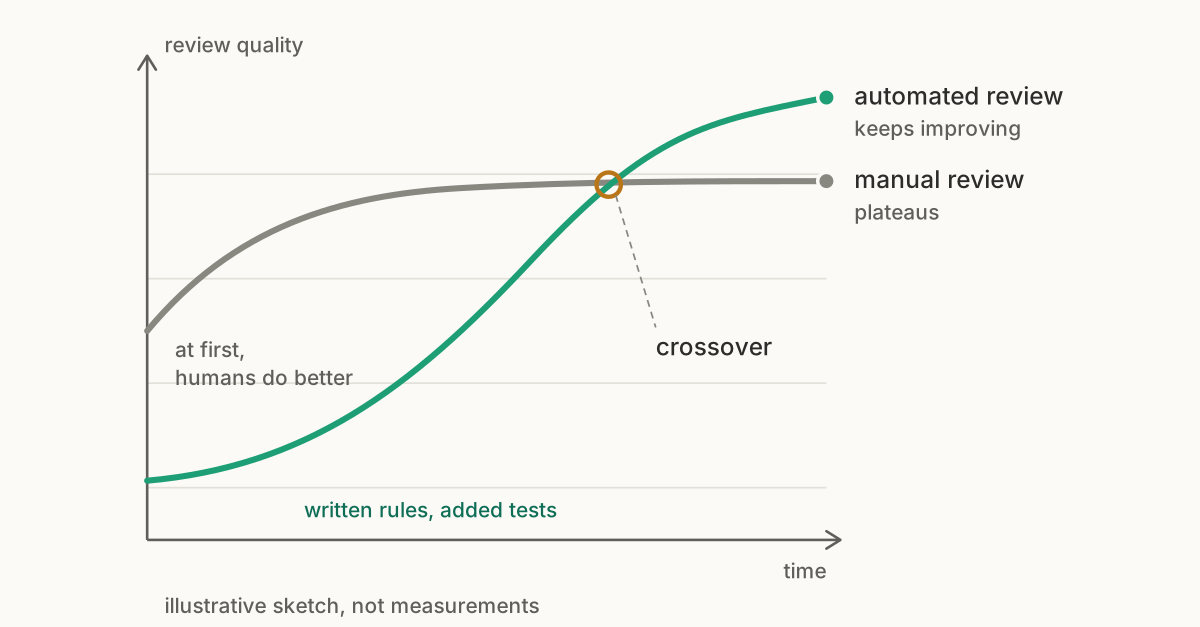
If the agent approves everything, it has to be right every time. Since it won’t be, we don’t start. That reasoning skips a step: delegating partly doesn’t require 100%. You can let the agent do the review, fixes included, and go over its work until you trust it enough. You can also try several variants of the review on PRs that were already reviewed, and keep only the ones that hold up. More on that in the next post.
DORA’s research on software delivery performance points the same way. In the Accelerate State of DevOps 2019 report, organisations that required a formal, heavyweight approval process were 2.6 times more likely to be among the low performers. The report doesn’t say why. My interpretation: a manual check plateaus, while an automated one improves with every rule you add to it. Review works the same way: starting to delegate, even badly, gives you something to improve.
3. We’ve never made explicit how we review
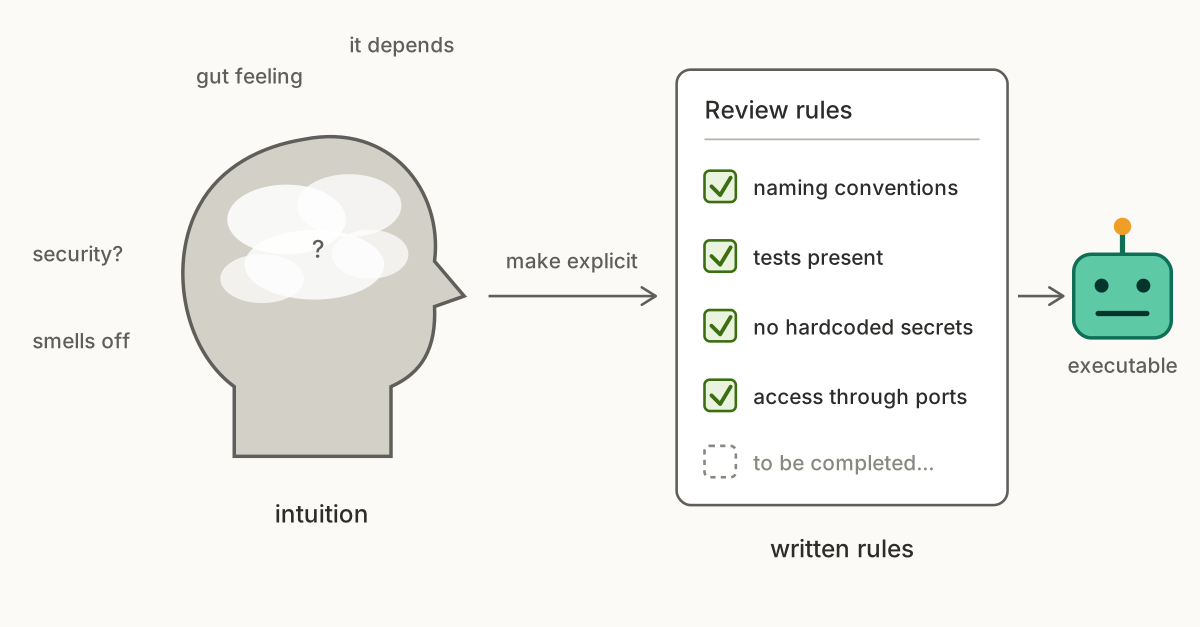
When we review a PR, we go by intuition. Ask yourself what really matters to you and what you look at first, and the answer doesn’t come right away. And from one PR to the next, we don’t review quite the same way. That’s flexible: you review a critical PR differently from a rename. But it’s also uneven, and a machine following written rules isn’t.
There’s at least one sign that it helps. In a paper presented at an ICML 2026 workshop, a small reviewer model inspects a Python codebase with 11 planted backdoors. With no constraints and no tools, it finds 54.5% of them. With constraints enforced on the code by tooling and a small documentation tool, it reaches 90.9%. It’s a small synthetic dataset, but the result is clear: the reviewer does better when you tell it what to check.
4. LLMs have jagged abilities
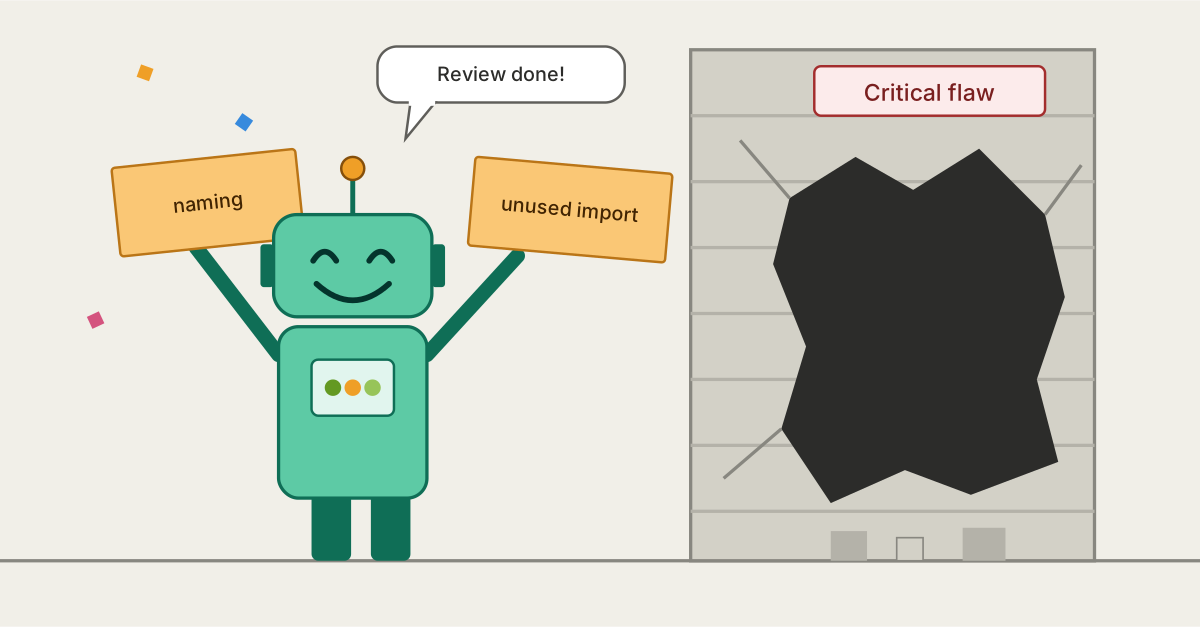
LLMs are excellent at some tasks and completely off at others, and we can’t yet tell in advance which one we’ll get. Andrej Karpathy calls this jagged intelligence, after models that solve hard problems but get wrong whether 9.11 is bigger than 9.9 (his original post). A Harvard, Wharton and BCG study had already described a “jagged technological frontier”, and Ethan Mollick popularised it in Centaurs and Cyborgs on the Jagged Frontier.
Imagine handing the review to a colleague who, one day out of two, does remarkable work and, the other day, misses the point entirely. You wouldn’t trust them with much.
5. Delegating to an agent goes through writing
With a colleague, you can say “do it with me a few times, and then you’ll know”. They watch, they understand what matters to us, and we gradually let go. With an agent, this learning by watching doesn’t exist: what you haven’t written down, it doesn’t know.
You can work around it in part. Have an agent go through the whole project along with the comments left on past PRs, and ask it to draw from them a model of what matters to us in review. It isn’t perfect, but the agent picks up some of what a colleague would learn by watching us work.
What now?
These five brakes are real, but just making them explicit lets you deal with them, and the agent then does better than a human fairly easily.
In the next post, I’ll tell you how we do it today, and what I finally have time to do instead.